Showing posts with label class 8. Show all posts

Thursday, April 30, 2020

CBSE Notes for Class 8 Computer in Action – Networking Concepts


CBSE Notes for Class 8 Computer in Action – Networking Concepts

Computer networks have shrunk the world and brought people together. They have extended the power of a computer beyond the expanse of a room. Advancements in networking techniques, protocols and so on have made a profound impact in areas of communication and learning. The size of computer networks may vary. The Internet is an example of a computer network that spreads all across the world. The Internet is also referred to as the worldwide network of computers and it is growing at a rapid rate.
A computer network
consists of two or more computers that are linked in order to share resources such as printers, exchange files and allow communication.
Let us learn more about computer networks.

NEED FOR COMPUTER NETWORKS
Nowadays, computer networks are a vital part of any organisation. Some of the advantages of computer networks are:

  • Resource Sharing: All computers in a network can share resources such as printers, fax machines, modems and scanners.
  • File Sharing and Remote Database Access: A computer network allows sharing of files and access to remote database. We can easily access the files stored on various computers on a network. Also, networking allows many people to work simultaneously on the data stored in a database.
  • Ease of Communication: Computer networks allow people to communicate through emails and instant messaging facilities. This makes the transmission of information easier, more efficient and less expensive.

TYPES OF COMPUTER NETWORKS
The following are the types of networks based on the geographical area covered or scale of the network.

  • Personal Area Network (PAN):
    A PAN is a computer network organised around a person. It is used for communication between devices such as phones, personal digital assistants, printers and laptops that are in close proximity. We can use these networks to transfer files and photos between the various devices
  • Local Area Network (LAN):
    A LAN is a computer network that is limited to a local area such as a laboratory, a school or an office building. Cables (wires) or low-power radiowaves (wireless) are used for the connections in a LAN. A wireless LAN (or WLAN) is also sometimes called LAWN (Local Area Wireless Network).
    cbse-notes-for-class-8-computer-in-action-networking-concepts-2
  • Campus Area Network (CAN):
    A CAN is a computer network that connects multiple local area networks (LAN) in a limited geographical area. A CAN is smaller than a wide area network (WAN) or metropolitan area network (MAN). It can be set up by a college, company and so on.
    cbse-notes-for-class-8-computer-in-action-networking-concepts-3
  • Metropolitan Area Network (MAN):
    A MAN is a computer network that usually covers a larger area than a LAN. For example, a network that connects two offices in a city, a neighbourhood area and so on.

cbse-notes-for-class-8-computer-in-action-networking-concepts-4

  • Wide Area Network (WAN):
    A WAN is a computer network that spans a wide geographical area. A WAN may be spread across cities, countries and continents. A WAN is formed by connecting LANs and MANs. Computers or networks across long distances are usually connected with optical fibre cables, satellite radio links or microwave radio links.

cbse-notes-for-class-8-computer-in-action-networking-concepts-5

NETWORK TOPOLOGIES
Topology refers to the layout pattern in which various computers are connected to one another to form a network. The computers on a network are also referred to as nodes.
There are four main types of topologies. They are:

  • Bus Topology: In bus topology, all the computers are connected to a single cable called the bus (Fig. 1.6). The transmission of data from any computer travels through the length of the bus in both the directions and can be received by all other computers on the network. If the address of a computer is that of the intended recipient, it accepts the data; otherwise, the data is rejected. The advantage of the bus topology is that it is quite easy to set up. However, a network cannot function if there are breaks in the bus.

cbse-notes-for-class-8-computer-in-action-networking-concepts-6

  • Ring Topology: In ring topology, each computer is connected to two other computers so as to form a closed ring-like structure (Fig. 1.7). In this topology, data is transmitted in one direction only. The disadvantage of the ring network is that the breakdown of any one computer on a ring can disable the entire system or network.

cbse-notes-for-class-8-computer-in-action-networking-concepts-7

  • Star Topology: In star topology, all the computers are connected to a central computer or a central node (Fig. 1.8). The data to be exchanged between any two computers passes through the central node. The central node controls all the activities of the nodes. More computers can be easily added to the network. The breakdown of computers, except the central node, does not affect the functioning of the network. However, the failure of the central node disables the communication across the entire network.

cbse-notes-for-class-8-computer-in-action-networking-concepts-8

  • Mesh Topology: In mesh topology, every computer is connected to every other computer on the network. Full mesh topology (Fig. 1.9) is very expensive to implement. Normally, partial mesh topology is implemented in which a computer is connected to a few other computers in the network  (Fig. 1.10).

cbse-notes-for-class-8-computer-in-action-networking-concepts-9

TRANSMISSION MEDIA
Computers must be connected to each other to form a network. Computers can be connected using wires/cables or they can be connected in a wireless manner.

Wired Transmission Media
There are various types of cables that can be used for setting up a network. Some of them are discussed here.

  • Twisted Pair Cable: It consists of a pair of insulated wires twisted together. The use of two wires twisted around each other helps to reduce disturbances in the signals.
    The twisted pair cable is often used in two or more pairs, all within a single cable. Twisted pair cabling comes in two varieties—shielded (Shielded Twisted Pair or STP) and unshielded (Unshielded Twisted Pair or UTP). UTP cable is the most commonly used cable in computer networking.
    The twisted pair cable is often used in two or more pairs, all within a single cable. Twisted pair cabling comes in two varieties—shielded (Shielded Twisted Pair or STP) and unshielded (Unshielded Twisted Pair or UTP). UTP cable is the most commonly used cable in computer networking.

cbse-notes-for-class-8-computer-in-action-networking-concepts-10

  • Coaxial Cable (coax): Coaxial cable is an electrical cable with a conductor at its centre (Fig. 1.13). The inner conductor is surrounded by a tubular insulating layer. The insulating layer is surrounded by a conductive layer called the shield, which is finally covered with a thin insulating layer on the outside.

cbse-notes-for-class-8-computer-in-action-networking-concepts-11

  • Optical Fibre Cable: Optical fibre cable consists of a central glass core surrounded by several layers of protective material (Fig. 1.14). It transmits data in the form of light rather than electronic signals, thus eliminating the problem of electrical interference. Fibre optic cable is expensive as  compared to coaxial and twisted pair cables but can transmit signals over much longer distances. It also has the capability to carry data at a very high speed.

cbse-notes-for-class-8-computer-in-action-networking-concepts-12

Wireless Transmission Media
In wireless networks, data is transmitted without wires. Some of the ways in which wireless networks may be set up are as follows.

  • Infrared: The infrared communication range of the devices communicating through infrared waves is very limited. Infrared waves cannot penetrate walls or other obstructions and so there should be no physical barrier between the communicating devices. The communication between a TV set and a remote control happens through infrared waves. Infrared mouse and keyboard are other examples of devices that make use of infrared waves for data transmission.
  • Microwave Transmission: Microwave communications are unidirectional. They can be used for terrestrial communication (on ‘the surface of the earth) or for satellite communication.
    Microwave propagation is line-of-sight communication. So, when used for terrestrial communication, the towers with antennas mounted on them need to be in direct sight of each other. The antennas are usually located at substantial heights above the ground level to extend the range between antennas and to be able to transmit over obstacles. You must have noticed high towers with microwave antennas in your city.
    Microwaves can pass through the earth’s atmosphere easily and can be used to transmit information between satellites and the earth’s base station

cbse-notes-for-class-8-computer-in-action-networking-concepts-13

  • Radiowave Transmission: Radiowave communications are omnidirectional, which means that they travel in all directions from the source, so that the transmitter and receiver do not have to be carefully aligned physically. Radio waves are easy to generate, can travel long distances and penetrate through buildings easily. So they are widely used for communication both indoors and outdoors (Fig. 1.17). However, at all frequencies, radio waves are subject to interference from motors and other electrical equipment.

cbse-notes-for-class-8-computer-in-action-networking-concepts-14

  • Bluetooth technology: is used for exchanging data over short distances using radio waves. This technology uses low power, has a short range [30 feet (approx.)] and medium transmission speed. Bluetooth technology can be used to transfer songs or pictures between two mobile phones or a Bluetooth headset can be used with a mobile phone.

cbse-notes-for-class-8-computer-in-action-networking-concepts-15

  • WiFi technology: also makes use of radio waves to transmit and receive data. This technology requires more energy but enables the signal to go farther (300 feet approx.) with a faster rate of transmission. This technology is used to set up networks in which a computer’s wireless adapter translates the data into a radio signal and transmits it. A wireless router receives the signal, decodes it and sends it to the Internet using a wired connection.

cbse-notes-for-class-8-computer-in-action-networking-concepts-16

  • WiMAX (Worldwide Interoperability for Microwave Access): Its technology is similar to WiFi, but it operates at higher speeds and can cover greater distances and greater number of users as compared to WiFi.

cbse-notes-for-class-8-computer-in-action-networking-concepts-17

NETWORK DEVICES
Various devices are used for setting up a computer network. Let us discuss a few devices that play a crucial role in a computer network.

  • NIC (Network Interface Card): It is a hardware device that is attached to a computer to enable it to communicate over the network (Fig. 1.21). The NIC has a ROM chip that contains a unique number, which is the hardware address or the Media Access Control (MAC) This hardware address uniquely identifies a computer on the network.

cbse-notes-for-class-8-computer-in-action-networking-concepts-18

  • Modem (Modulator-demodulator): It is an electronic device that converts the digital signals of a computer into an analog form so that they can travel over a telephone line (Fig. 1.22). At the destination, the receiving modem converts the analog signals back into their digital form so that the destination computer understands them.

cbse-notes-for-class-8-computer-in-action-networking-concepts-19

  • Modems are used for connecting computers to the Internet. Modems are connected to a computer and a telephone line.(Fig. 1.24).

cbse-notes-for-class-8-computer-in-action-networking-concepts-20

  • Hub: A hub is a device that is used to connect computers in a network (Fig. 1.23). In a hub, when one computer sends data on the network, the hub simply forwards the packets to all the other computers connected to it (Fig. 1.26). Each computer is responsible for determining which packets are destined for it and which are to be ignored.

cbse-notes-for-class-8-computer-in-action-networking-concepts-21

  • Switch: A switch is a device that is also used to connect computers in a network (Fig. 1.27). However, a switch is a more intelligent device than a hub. Unlike a hub, the switch sends the incoming data to the desired destination only. It records the addresses of all the computers connected to it. So, when a packet is received, the switch reads the information about the destination address to determine if the destination device is connected to it or not. If the destination device is connected, the switch forwards the packet only to that destination device. In this way, the other computers do not have to read and deal with data that is not meant for them.

cbse-notes-for-class-8-computer-in-action-networking-concepts-22

  • Router: A router is a network device that connects two or more networks. It is commonly used to connect a computer or a network to the Internet. Lines from different networks are connected to a router. Wireless routers are also available. A router examines the address of the packet coming on the line, uses the routing information stored in it and forwards the packet to the next network. In this way, a packet after going through multiple routers reaches its destination.

cbse-notes-for-class-8-computer-in-action-networking-concepts-23

PROTOCOLS
Just the way we follow certain rules while communicating or travelling on the road, similarly rules or protocols have to be followed for effective network communication. Protocol is a set of rules used by computers on a network to communicate with each other. Some examples of protocols are:

  • HTTP (Hyper Text Transfer Protocol): It is a protocol used between a web server and a web browser for transferring HTML pages.
  • TCP/IP (Transmission Control Protocol/Internet Protocol): TCP is a protocol that is used along with the IP to send data over the Internet. The information is transmitted across the Internet in the form of bundles called TCP is responsible for dividing the data into packets before they are sent and for reassembling the packets when they arrive at the destination. IP is a set of specifications that determines the best route for the packets across the Internet so that the packets reach their destination address.

PACKET SWITCHING IN NETWORKS
Let us explain the process of packet switching in a LAN. Suppose data has to be sent from Computer A to Computer B. The data at Computer A is split into small chunks, called packets. A header is added to every packet. The address of sender i.e. Computer A and address of receiver i.e. Computer B are put in the header. Then Computer A sends the packets to the switch. The switch has in-built software that

cbse-notes-for-class-8-computer-in-action-networking-concepts-24

reads the header of each packet, determines the port at which the receiver is connected and forwards the packet on the corresponding cable (Fig. 1.29). Such a type of communication in which small units of data (or packets) are routed through a network, based on the destination address contained within each packet, is called packet switching. When packets have to be sent to a computer on a different network, they pass through a number of routers. Every packet is numbered. Packets may follow different paths to reach the destination.

cbse-notes-for-class-8-computer-in-action-networking-concepts-25

NETWORK SECURITY
A computer on a network can be accessed by many users. Security measures have to be taken to protect networks from unauthorised access and to prevent data or information theft.

Threats to Computer
Files can be shared between the computers on a network. This makes a computer vulnerable to attacks by viruses, worms, Trojan horses and so on that can easily spread because of the underlying network. Let us discuss some of the common threats to computers.

  • Virus: A computer virus spreads itself from one computer to another and interferes with the normal operations of a computer. Viruses attach themselves to any type of file and spread when these infected files are copied to other computers. People unknowingly spread a computer virus by sharing infected files or sending emails with viruses as attachments.
  • Worm: A worm is a computer program that uses computer networks to send copies of itself to other computers on a network. A virus requires  human action such as transferring of an infected file to spread itself. A worm can spread without any human action too. It replicates itself without the knowledge of the user. Worms can cause severe harm to a computer network such as blocking the network and reducing the speed of the network.
  • Trojan Horse: A computer program that appears to be a useful software but actually causes damage once installed or executed onto your computer system is known as a Trojan horse or a Trojan. After getting installed, it allows unauthorised access to the computer. Trojan horses are very dangerous as they allow your computer to be remotely controlled by someone else and can cause loss of personal and confidential information.
    Viruses, worms and Trojan horses may harm the data or affect the performance and the speed of a computer.

cbse-notes-for-class-8-computer-in-action-networking-concepts-26

  • Data Theft: It is a very serious problem for computer networks. People break into computer networks to either disrupt their functioning or to steal confidential information. Hackers are the computer experts who can break into computer systems and networks. There are two types of hackers—white hackers and black hackers.
  • White hackers: study and break into networks to find and fix security loopholes. They offer their to corporations, public organisations and educational institutions to make their networks more secure.
  • Black hackers or crackers: have a criminal intention. Some examples are cracking bank accounts in order to transfer money to their own accounts, stealing confidential information and attacking the computer network of an organisation for money.

Computer Security

  • Antivirus Software: Every computer on a computer network must have an antivirus software installed in it and it should be updated on a regular basis. Antivirus software can be used to protect the computer from various types of malware. Antivirus software can detect viruses, worms and so on, and warn you of their presence in your computer. It can also deactivate and clean up the computer of malicious software.
    There are various types of antivirus software such as AVG, Avira, Norton and McAfee

cbse-notes-for-class-8-computer-in-action-networking-concepts-27

  • Firewall: A firewall is used to prevent unauthorised access to a computer network. A firewall  can be implemented as a software, a hardware or a combination of both. All data or messages entering or leaving a computer network pass through a firewall (Fig. 1.33). A firewall examines each message and blocks those that do not meet the specified security critaria

Tuesday, April 28, 2020

class 8 Chapter 10 Reaching the Age of Adolescence

class 8 Chapter 10 Reaching the Age of Adolescence

Exercise Questions

1. What is the term used for chemical secretions of endocrine glands responsible for changes taking place in the body?

Soln:

The chemical substance secreted by the endocrine glands is called Hormones. Hormones are responsible for the changes taking place in the body.

 2. Define adolescence.

Soln:

The time period which comes between the beginning of adulthood and puberty is called Adolescence. In this time period, the body undergoes different changes alongside reproductive maturity. It starts somewhat at the age of 11 and ends at the age of 18 or19. This period of adolescence may differ from person to person.

3. What is menstruation? Explain

Soln:

The process of shedding of the uterine lining on a regular monthly basis is called menstruation. It starts at puberty and in the reproductive cycle of the female body. The uterus prepares itself to receive a fertilized egg on every month. Due to this the inner lining of the uterus become thick and is supplied with blood to nourish the embryo. If the egg is not fertilized, then the lining of the uterus breaks down and get released in the form of blood through the vagina. The time period for this is about 2 to 8 days every month. This monthly cycle is known as the menstrual cycle.

4. List changes in the body that take place at puberty

Soln:

The changes that take place at the time of puberty are as follows:

a) The height and weight of the body will suddenly increase

b) The hair seems to appear in the area such as legs, hands, face and underarms

c) In female, the enlargement of the ovary takes place and starts producing matured eggs and on the other hand in males, the testis grows and starts producing sperms

d) In males, the shoulder broadens and chest becomes widen, whereas in females the region below the waist becomes wider.

e) The acne seems to appear because of the excessive secretion of the oil from the skin.

f) In boys, the larynx becomes prominent under the influence of hormones, the vocal cord becomes longer and thicker resulting in hoarse voice.

5. Prepare a Table having two columns depicting names of endocrine glands and hormones secreted by them.

Soln:

Endocrine GlandsHormones
TestisTestosterones
OvaryOestrogen
PituitaryGrowth hormone
AdrenalAdrenalin
ThyroidThyroxin
PancreasInsulin

6. What are sex hormones? Why are they named so? State their function

Soln:

The chemical substances produced by the sex organs are called sex hormones. For example, in females, the sex hormones produced by the ovary is called oestrogen and in males, the sex hormones produced by the testis is called testosterone.

Some of the functions performed by the sex hormones:

Oestrogen: This hormone is responsible for the development of secondary sexual characters in females like enlargement of breasts, development of female reproductive organs etc.

Testosterone: this hormone brings the secondary sex character in boys such as the growth of beard, the voice becomes hoarse, development of the reproductive organs etc.

7. Choose the correct option.

(a) Adolescents should be careful about what they eat, because

(i) proper diet develops their brains.

(ii) proper diet is needed for the rapid growth taking place in their body.

(iii) adolescents feel hungry all the time.

(iv) taste buds are well developed in teenagers.

(b) Reproductive age in women starts when their

(i) menstruation starts.

(ii) breasts start developing.

(iii) body weight increases.

(iv) height increases.

(c) The right meal for adolescents consists of

(i) chips, noodles, coke.

(ii) chapati, dal, vegetables.

(iii) rice, noodles and burger.

(iv) vegetable cutlets, chips and lemon drink.

Soln:

a) (iv) taste buds are well developed in teenagers.

b) (iii) body weight increases.

c) (ii) chapati, dal, vegetables.

8. Write notes on—

(a) Adam’s apple.

(b) Secondary sexual characters.

(c) Sex determination in the unborn baby.

Soln:

a) Adam’s apple: In human males, the larynx grows larger at the time of puberty and can be seen as a protruding part of the throat. This protrusion is known as Adam’s apple. In boys under the influence of sex hormones, the larynx becomes prominent. Due to this, the vocal cord becomes thicker and longer which causes the voice hoarse. On the other hand in females, the larynx is of small size and is hardly visible. Therefore, girls have a high pitched voice while the boys has deep voice.

9. Word game :

Use the clues to work out the words.

Across

3. Protruding voice box in boys

4. Glands without ducts

7. Endocrine gland attached to brain

8. Secretion of endocrine glands

9. Pancreatic hormone

10. Female hormone

Down

1. Male hormone

2. Secretes thyroxine

3. Another term for teenage

5. Hormone reaches here through blood stream

6. Voice box

7. Term for changes at adolescence

Reaching the Age of Adolescence-1

Soln:

Across

  1. Adam’s apple
  2. Endocrine
  3. Pituitary
  4. Hormone
  5. Insulin
  6. Estrogen

Down

  1. Testosterone
  2. Thyroid
  3. Adolescence
  4. Target site
  5. Larynx
  6. Puberty

8 Science Chapter 10 NCERT Solutions reaching the Age of Adolescence

Section NumberTopics
10.1Adolescence and Puberty
10.2Changes at Puberty
10.3Secondary Sexual Characters
10.4Role of Hormones in Initiating Reproductive Function
10.5Reproductive Phase of Life in Humans
10.6How is the Sex of the Baby Determined
10.7Hormones other than Sex Hormones
10.8Role of Hormones in Completing the Life History of Insects and Frogs
10.9Reproductive Health

What is the term used for chemical secretions of endocrine glands responsible for changes taking place in the body?

The chemical substance secreted by the endocrine glands is called Hormones. Hormones are responsible for the changes taking place in the body.

Define adolescence?

The time period which comes between the beginning of adulthood and puberty is called Adolescence. In this time period, the body undergoes different changes alongside reproductive maturity. It starts somewhat at the age of 11 and ends at the age of 18 or19. This period of adolescence may differ from person to person.

What is menstruation?

The process of shedding of the uterine lining on a regular monthly basis is called menstruation.

What are sex hormones?

The chemical substances produced by the sex organs are called sex hormones.

cbse class 8 Chapter 9 Reproduction in Animals

class 8 Chapter 9 Reproduction in Animals

Chapter 9 Exercise Questions

1. Explain the importance of reproduction in organisms.

Soln:

Importance of reproduction in organisms are as follows

  • Reproduction is termed to be a biological process in which organisms give birth to their off springs.
  • It helps in maintaining the continuity of a particular race and helps in increasing the population of the species.
  • Reproduction is meant for the survival of all living things.

2. Describe the process of fertilisation in human beings.

Soln:

  • Fertilization is defined as the process in which there is a fusion of male gamete and female gamete.
  • The male gametes or sperms are released from the male reproductive organ called the penis
  • The sperms released to enter the female body through the vagina.
  • From the vagina, sperms travel through the fallopian tubes where they meet the eggs.
  • From there on, the process of fertilization takes place in the fallopian tube.
  • The male gamete cell (sperm) and female gamete cell (egg) fuse together to form a zygote.
  • The zygote divides rapidly to form a group of cells called morula, which becomes the embryo after approximately five days. The foetus is present for about eight weeks after the fertilization.

3. Choose the most appropriate answer.

(a) Internal fertilisation occurs

(i) in female body.

(ii) outside female body.

(iii) in male body.

(iv) outside male body.

(b) A tadpole develops into an adult frog by the process of

(i) fertilisation

(ii) metamorphosis

(iii) embedding

(iv) budding

(c) The number of nuclei present in a zygote is

(i) none

(ii) one

(iii) two

(iv) four

Soln:

a) (i) in female body.

b) (ii) metamorphosis

c) (iii) two

4. Indicate whether the following statements are True (T) or False (F).

(a) Oviparous animals give birth to young ones. ( )

(b) Each sperm is a single cell. ( )

(c) External fertilisation takes place in frog. ( )

(d) A new human individual develops from a cell called gamete. ( )

(e) Egg laid after fertilisation is made up of a single cell. ( )

(f) Amoeba reproduces by budding. ( )

(g) Fertilisation is necessary even in asexual reproduction. ( )

(h) Binary fission is a method of asexual reproduction. ( )

(i) A zygote is formed as a result of fertilisation. ( )

(j) An embryo is made up of a single cell. ( )

Soln:

a) False

b) True

c) True

d) False

e) True

f) False

g) False

h) True

i) True

j) False

5. Give two differences between a zygote and a foetus.

Soln:

Zygote:

  • It is the earliest stage of development
  • It is formed by the fusion of male and female gametes
  • It is a single cell
  • The zygote divides several times to form an embryo
  • The zygote normally lasts a week and then develop into its next stage.

Foetus

  • It is the last developmental stage of an organism
  • The stage of the embryo that shows all the main recognizable body parts of a mature organism.
  • The foetus stage occurs after the embryo stage.
  • Foetus mainly undergoes internal development.

6. Define asexual reproduction. Describe two methods of asexual reproduction in animals.

Soln:

In this type of reproduction, the offspring arises from a single organism without the fusion of male and female gametes. It never changes the number of chromosomes.

Binary fission in amoeba

  • It is a kind of asexual reproduction in which one cell divides into two halves.
  • It is a unicellular organism that has a cell membrane, cell wall and cytoplasm.
  • The division of the cell can take place on any plane.
  • In this process, the nucleus of the amoeba first divides to form two daughter nuclei by the process called Karyokinesis.
  • Finally, the division of the body into two halves having a nucleus respectively takes place.

Binary fission in amoeba

Budding in hydra

  • Organisms such as hydra, use regenerative cells for reproduction in the process of budding.
  • The first step is the formation of buds, and it develops as a small outgrowth on the parent’s body.
  • As the bud enlarges, it receives the characteristics of the parent organism.
  • Once it is developed, it may be detached from the parent body and develop into a new individual.
  • In some rare cases, the buds may not be detached forming interconnected buds.
  • There are also methods like fragmentation, multiple fission etc.

Budding in hydra

7. In which female reproductive organ does the embryo get embedded?

Soln:

  • In the female reproductive organ, the embryo gets attached to the uterus.
  • Once it gets attached, there occurs the formation of body parts like legs, hands, eyes etc.
  • The embryo is then called a foetus.

8. What is metamorphosis? Give examples.

Soln:

  • It is defined as the process in which an animal’s body structure abruptly changes through cell growth and differentiation.
  • It is a biological process.
  • Examples of this kind are frog and insects.

Metamorphosis in Frog

The life cycle of a frog:

The tadpole emerging from the egg will have gills, tail etc.

They can swim easily in water.

It undergoes abrupt changes and develops into a mature frog.

9. Differentiate between internal fertilisation and external fertilisation.

Soln:

Fertilization, in general, is defined as the fusion of a male and a female gamete.

Internal fertilization

It occurs inside the female body.

There are high chances of survival of the offspring.

Internal fertilization protects the fertilized egg or embryo from harsh environments.

Examples are cow, humans, dogs, monkeys etc.

External fertilization

It occurs outside the female body.

There are low chances of survival of the offspring.

Most aquatic animals use this type of fertilization and the advantage of external fertilization is that it produces a large number of offspring due to external hazards.

Examples are fish, frog, organisms etc.

10. Complete the crossword puzzle using the hints given below.

Across

1. The process of the fusion of the gametes.

6. The type of fertilisation in hen.

7. The term used for bulges observed on the sides of the body of hydra.

8. Eggs are produced here.

Down

2. Sperms are produced in these male reproductive organs.

3. Another term for in vitro fertilisation.

4. These animals lay eggs.

5. A type of fission in amoeba

Crossword Puzzle on Reproduction in Animal-1

Soln:

Across

1) Fertilization

6) Internal

7) Buds

8) Ovary

Down

2) Testis

3) Zygote

4) Oviparous

5) Binary

This chapter comprises of various topics like-

  • Reproduction
  • Modes of reproduction
  • Fertilization
  • Development of embryo
  • Viviparous and Oviparous animals
  • Young ones to adults
  1. Reproduction – It is a procedure in which the organisms reproduce their young ones. There are 2 methods of reproduction. Namely – Sexual reproduction and asexual reproduction.
  2. Sexual reproduction – Reproduction ensuing from the combination of the female and male gametes is called sexual reproduction. The reproductive organs in the female comprise of – ovaries, oviducts and uterus. And, the reproductive organs in the male comprises of – testes, sperm ducts and penis. The unification of ovum and sperm is called fertilization. The fertilized egg is known as the zygote.
  3. Asexual reproduction – When a single parent is involved, then it is termed as asexual reproduction.  New cells develop from buds in hydra. This mode of asexual reproduction is known as budding. Amoeba reproduces itself by dividing into 2 and this type of reproduction is termed as binary fission
  4. Explain the importance of reproduction in organisms?

    • Reproduction is termed to be a biological process in which organisms give birth to their off springs.
    • It helps in maintaining the continuity of a particular race and helps in increasing the population of the species.
    • Reproduction is meant for the survival of all living things.

    Describe the process of fertilisation in human beings?

    • Fertilization is defined as the process in which there is a fusion of male gamete and female gamete.
    • The male gametes or sperms are released from the male reproductive organ called the penis
    • The sperms released to enter the female body through the vagina.
    • From the vagina, sperms travel through the fallopian tubes where they meet the eggs.
    • From there on, the process of fertilization takes place in the fallopian tube.
    • The male gamete cell (sperm) and female gamete cell (egg) fuse together to form a zygote.
    • The zygote divides rapidly to form a group of cells called morula, which becomes the embryo after approximately five days. The foetus is present for about eight weeks after the fertilization.

    Differences between a zygote and a foetus?

    Zygote:

    • It is the earliest stage of development
    • It is formed by the fusion of male and female gametes
    • It is a single cell
    • The zygote divides several times to form an embryo
    • The zygote normally lasts a week and then develop into its next stage.

    Foetus

    • It is the last developmental stage of an organism
    • The stage of the embryo that shows all the main recognizable body parts of a mature organism.
    • The foetus stage occurs after the embryo stage.
    • Foetus mainly undergoes internal development.

    Define asexual reproduction?

    In this type of reproduction, the offspring arises from a single organism without the fusion of male and female gametes. It never changes the number of chromosomes.

    What is metamorphosis?

    It is defined as the process in which an animal’s body structure abruptly changes through cell growth and differentiation.

class 8 Chapter 8 Cell – Structure and Functions

class 8 Chapter 8 Cell – Structure and Functions

Exercise Questions

1. Indicate whether the following statements are True (T) or False (F).

(a) Unicellular organisms have one-celled body. (T/F)

(b) Muscle cells are branched. (T/F)

(c) The basic living unit of an organism is an organ. (T/F)

(d) Amoeba has irregular shape. (T/F)

Soln:

a)True

b) False

c) False

d) True

2. Make a sketch of the human nerve cell. What function do nerve cells perform?

Soln:

Human Nerve cell

The main function of the nerve cell is to transmit messages to the brain from receptor organs and vice versa. It has control over the working of different parts of the body.

3. Write short notes on the following.

(a) Cytoplasm

(b) Nucleus of a cell

Soln:

(a) Cytoplasm:

The cytoplasm is a fluid that contains all the cell organelles such as the Mitochondria, Ribosomes, Golgi bodies, etc. It is present between the nucleus and the plasma membrane. It helps in the exchange of materials between cell organelles. It is made up of eighty percent water and is usually clear and colourless.

(b) The nucleus of a cell:

The Nucleus is a double-membrane bound cell organelle present in eukaryotic cells. It contains the DNA, the genetic material. It is the command centre of the cell and is spherical in shape. It has the following components:

Cell and Nucleaus Diagram

  • Nuclear membrane
  • Nucleolus
  • Chromosomes
  1. Nuclear membrane:

It has is a double-layered membrane. It separates the contents of the nucleus from the cytoplasm and acts as a wall. It has pores that allow the transfer of certain substances in and out of the cell.

2. Nucleolus:

It is a small dense spherical body. It is not bound by any membrane.

3. Chromosome:

These are thread-like structures that carry genes. All the necessary information required for the transfer of characteristics from the parents to the offspring are stored in the genes. Inheritance of characteristics is possible only because of chromosomes.

4. Which part of the cell contains organelles?

Soln:

Various cell organelles are present in the cytoplasm. It is a clear and colorless fluid that contains organelles like Mitochondria, Ribosomes, Golgi bodies.

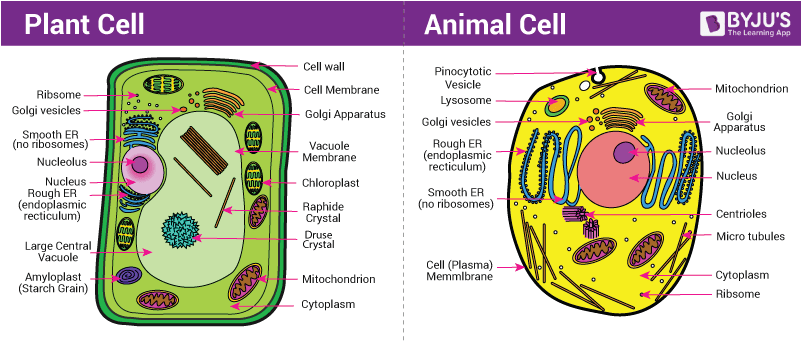
5. Make sketches of animal and plant cells. State three differences between them.

Soln:

Plant cellAnimal cell
They are large in sizeThey are smaller than plant cells
The cell wall is presentThe cell wall is absent
Vacuoles are largeVacuoles are small
Plastids could be seenExcept for Euglena, Plastids could not be seen in animal cells.

Animal and plant cell

6. State the difference between eukaryotes and prokaryotes.

ProkaryotesEukaryotes
Most of them are unicellularMost of them are multicellular
There is no nuclear membrane. So,

the nucleus is poorly defined.

There is a nuclear membrane. So, the nucleus is well defined.
Not all cell organelles are presentAll the cell organelles are present.
Nucleolus is absentNucleolus is present
Eg: Blue-green algae, BacteriaEg: Plant, Animal cells and Fungi.

7. Where are chromosomes found in a cell? State their function.

Soln:

Chromosomes are thread-like structures present in the nucleus that carry genes. All the necessary information required for the transfer of characteristics from the parents to the offspring are stored in the genes. Inheritance of characteristics is possible only because of chromosomes.

8. ‘Cells are the basic structural units of living organisms’. Explain.

Soln:

Various components of plants and animals are constituted by cells. It is the smallest unit of life and is capable of all living functions. They are the building blocks of life. That is the reason why cells are referred to as ‘the basic structural and functional blocks of life’.

Cells exist in various shapes and sizes and perform a wide range of activities.

Their shapes and sizes are related to the function it performs.

9. Explain why chloroplasts are found only in plant cells?

Soln:

Chloroplasts are plastids required for the food making process, called photosynthesis, and thus they are only present in plant cells.

10. Complete the crossword with the help of clues given below.

Across

1. This is necessary for photosynthesis.

3. Term for component present in the cytoplasm.

6. The living substance in the cell.

8. Units of inheritance present on the chromosomes.

Down

1. Green plastids.

2. Formed by collection of tissues.

4. It separates the contents of the cell from the surrounding medium.

5. Empty structure in the cytoplasm.

7. A group of cells.

Crossword Puzzle on Cell-Structure and Functions-1

Soln:

Across

  1. Chlorophyll
  2. Organelle
  3. Protoplasm
  4. Genes

 Down

  1. Chloroplasts
  2. Organ
  3. Membrane
  4. Vacuole
  5. Tissue

Crossword Puzzle on Cell-Structure and Functions

What is Cytoplasm?

The cytoplasm is a fluid that contains all the cell organelles such as the Mitochondria, Ribosomes, Golgi bodies, etc. It is present between the nucleus and the plasma membrane. It helps in the exchange of materials between cell organelles. It is made up of eighty percent water and is usually clear and colourless.

Define Nucleus of a cell?

The Nucleus is a double-membrane bound cell organelle present in eukaryotic cells. It contains the DNA, the genetic material. It is the command centre of the cell and is spherical in shape.

Which part of the cell contains organelles?

Various cell organelles are present in the cytoplasm. It is a clear and colorless fluid that contains organelles like Mitochondria, Ribosomes, Golgi bodies.

Where are chromosomes found in a cell?

Chromosomes are thread-like structures present in the nucleus that carry genes. All the necessary information required for the transfer of characteristics from the parents to the offspring are stored in the genes. Inheritance of characteristics is possible only because of chromosomes.

Explain why chloroplasts are found only in plant cells?

Chloroplasts are plastids required for the food making process, called photosynthesis, and thus they are only present in plant cells.

class 8 Chapter 7 Conservation of Plants and Animals

 class 8 Chapter 7 Conservation of Plants and Animals

Exercise Questions

1. Fill in the blanks.

(a) A place where animals are protected in their natural habitat is called _________ .

(b) Species found only in a particular area is known as _______ .

(c) Migratory birds fly to faraway places because of __________ changes.

Soln:

(a) A place where animals are protected in their natural habitat is called Sanctuary.

(b) Species found only in a particular area is known as endemic .

(c) Migratory birds fly to faraway places because of climatic changes.

2. Differentiate between the following.

(a) Wildlife sanctuary and biosphere reserve

(b) Zoo and wildlife sanctuary

(c) Endangered and extinct species

(d) Flora and fauna

Soln:

(a)

Wildlife sanctuaryBiosphere Reserve
An area within which wild animals are protected from external dangers like huntingAn area constructed for the conservation of biodiversity
Adequate habitat and protection are provided for the wild animals living in a sanctuarySeveral life forms like plants, animals, and micro-organisms conservation are possible in a reserve
Eg: Corbett national parkEg: Nilgiri Biosphere reserve

(b)

ZooWildlife Sanctuary
Animals are kept in artificially constructed facilities for public exhibition.An area within which wild animals are protected from external dangers like hunting.
It is an artificial habitat and the animals may or may not adapt to the new conditions.The animals are conserved within their natural habitat itself. So, they won’t have a problem with their surroundings.

(c)

Endangered SpeciesExtinct Species
The species which are on the verge of extinction are called as Endangered species.The species of animals or plants that no longer exist are called Extinct species.
Eg: Bengal Tiger, Blue Whale, etc.Eg: Caribbean monk seal, Great Auk, Passenger pigeon.

(d)

FloraFauna
It is the collective name for the plant life from a particular area.It is the collective name for the animal life from a particular area
Eg: Spurge and Hogweed from the Nilgiris regionEg: Langur, Tiger, Tahr from the Nilgiris region.

3. Discuss the effects of deforestation on the following.

(a) Wild animals

(b) Environment

(c) Villages (Rural areas)

(d) Cities (Urban areas)

(e) Earth

(f) The next generation

Soln:

(a) Effects of deforestation on wild animals:

Removal of trees and plant life from a particular area for the construction of industries, agriculture or for other such purposes is termed as Deforestation. Plant life forms an integral part of the ecosystem and these plants form the natural habitat of various animals of that ecosystem. Destroying the plant life will ultimately threaten the existence of animals in that particular ecosystem and may lead to their extinction.

(b) Effects of deforestation on the environment:

In plants, Photosynthesis takes place by the absorption of CO2 from the earth’s atmosphere. The percentage of COin the atmosphere increases rapidly if the plant life of an area is destroyed. Increased concentrations of COresult in the trapping of excessive heat radiations within the Earth’s atmosphere contributing to global warming. This results in the rise of the temperature of the Earth and disturbs the water cycle which occurs in nature. Hence, rainfall pattern changes leading to droughts and floods.

(c) Effects of deforestation on villages:

The soil particles are held together in a place by the roots of the plants, trees and other vegetation. In the event of water flow or a high-speed wind over the top layer of the soil, the soil particles get removed easily as there are no plants to hold it in place. Thus, Soil erosion is increased by deforestation activities. Soil loses fertility and loses humus. Hence, a fertile land, fit for agriculture turns into a desert.

(d)Effects of deforestation on cities:

The risk of natural calamities like floods and drought in urban areas is increased by deforestation. It will also lead to global warming because of increased CO2 levels in the atmosphere. This is a result of continuous pollution from automobiles and industries. The water cycle in the vicinity is also affected.

(e) Effects of deforestation on Earth:

Deforestation leads to increased chances and occurrences of desertification, droughts and floods. Carbon Dioxide level in the earth’s atmosphere also increases which leads to global warming. The water cycle is disrupted and also there is an increased risk of natural calamities.

(f) Effects of deforestation on the next generation:

Our Environment is slowly changed by the activities of deforestation, both directly and indirectly. Soil erosion, global warming, desertification, drought, greenhouse effect, floods and many other problems are caused only because of deforestation. Ultimately, the next generation will be facing the consequences of deforestation.

4. What will happen if

(a) we go on cutting trees

(b) the habitat of an animal is disturbed

(c) the top layer of soil is exposed

Soln:

(a) If we go on cutting the trees

If we go on cutting the trees, the animals will lose their natural habitat as essential part of their ecosystem are destroyed. This reduces the biodiversity of the affected areas. The temperature of the Earth also increases and gives way to global warming. Global warming, in turn, affects the water cycle. Hence, rainfall pattern changes leading to droughts and floods. Risks of soil erosion, global warming, desertification, greenhouse effect increases.

(b) If the habitat of an animal is disturbed

All the basic necessities for an animal, like food, water, shelter and protection is provided by the habitat in which the animal lives-in disturbing the habitat of the animal forces it to move to another place in search of food, water, shelter and protection. The animal, in due course, may get killed by other animals.

(C) If the top layer of the soil is removed

Removing the top layer of the soil gradually exposes the lower layers of the soil. The lower layers of the soil are hard and rocky in nature and are less fertile. This is because of the reduced quantity of humus. Soil erosion on a continued basis will turn it barren and infertile.

5. Answer in brief.

(a) Why should we conserve biodiversity?

(b) Protected forests are also not completely safe for wild animals. Why?

(c) Some tribals depend on the jungle. How?

(d) What are the causes and consequences of deforestation?

(e) What is Red Data Book?

(f) What do you understand by the term migration?

Soln:

(a) The number and variety of various life forms such as plants, animals and micro-organisms in the area are called Biodiversity. Both plants and animals have a mutual dependence on each other for their survival. As they are related to one another, destruction of one will automatically destroy the other. Hence, biodiversity has to be conserved in order to maintain nature’s balance.

(b) People who live near the forests depend on the resources of the forests in order to fulfil their day-to-day needs. Therefore, it is not safe for animals living in protected forests. The animals would be threatened by the presence of the human population. This results in the killing of wild animals and selling their products for huge sums of money.

(c) The forests provide food, fodder and other resources to the tribal people. It is inevitable for them to depend on forests and their resources for everyday needs.

(d) Causes of deforestation:

There are a lot of causes for deforestation. A few of them are listed below.

I. In order to accommodate the ever-expanding urban population, forest areas are often cleared and converted into lands for various uses.

II. For agricultural activities like crop cultivation and cattle grazing, forest lands are cleared.

III. Firewood is a major product from the forests and it is one of the main reasons for cutting the trees on a large scale.

Consequences of deforestation:

There are a lot of fatal consequences caused by deforestation. A few of them are listed below.

  1. Soil erosion
  2. Loss of Biodiversity
  3. Floods
  4. Droughts
  5. Global warming as a result of climate change
  6. Disruption of the water cycle

(e) Red data book is basically a sourcebook which has an international list of all plant and animal species which are endangered, that is, on the verge of extinction. The International Union for Conservation of Nature and Natural resources (IUCN) maintains the books and adds/ removes the names of the species by conducting a comprehensive survey.

(f) The movement of an organism or a group of organisms from its natural habitat to another place on a standard basis at a particular time of each and every year is known as migration. The organisms do so in order to avoid uninhabitable conditions of climate or for the process of breeding.

6. In order to meet the ever-increasing demand in factories and for shelter, trees are being continually cut. Is it justified to cut trees for such projects? Discuss and prepare a brief report.

Soln:

No. Cutting trees in order to meet the ever growing demands of the human population is not at all justified. There are a vast number of organisms like wild animals, insects, and birds living in the forests. The forests provide good quality air for both animals and humans. This is because of the process of plants respiration by which, they consume the harmful carbon dioxide and give out good quality Oxygen. Thus, keeping greenhouse gases and global warming under check. The roots of the flora of the forests help in preventing soil erosion. Natural Calamities such as floods and droughts could also be prevented by their presence. They help in increasing the soil’s fertility and conserving the biodiversity of the ecosystem.

Overutilization of forests and its resources by cutting a large number of trees in order to satisfy the demands of the ever-increasing human population leading to many long-term problems like

  • Soil erosion
  • Greenhouse effect
  • Global warming
  • Floods
  • Droughts

Besides the above-listed problems, the effects of large-scale deforestation will be leaving an everlasting mark on the face of human civilization. The balance of nature is disturbed by the destruction of trees. Hence, it is of utmost priority and importance to conserve forests.

7. How can you contribute to the maintenance of green wealth of your locality? Make a list of actions to be taken by you.

Soln:

I can take care of the green cover of my locality by growing plants in my locality. I shall motivate the people of my neighbourhood to plant more trees and take care of the existing trees by creating awareness about the importance of plant life in an ecosystem. In order to make this possible, I would initiate the proceedings and organize weekly events on the same. Creating awareness among the children and youth would be of top priority as they will easily understand the issues that we are facing. Planting new trees is as important as looking after the existing ones. So, my volunteers and I would water the plants and trees on a regular basis.

8. Explain how deforestation leads to reduced rainfall.

Soln:

Removal of trees and plant life from a particular area for the construction of industries, agriculture and other purposes is termed as Deforestation. Photosynthesis, in plant life, takes place by the absorption of CO2 from the earth’s atmosphere. When the plant life is destroyed, the Carbon Dioxide levels in the atmosphere will increase drastically leading trap of heat radiation which causes global warming. This rise in temperature will affect the water cycle. Disturbance in the water cycle will lead to a chain of events and in the end, the rainfall pattern changes and results in droughts.

9. Find out about national parks in your state. Identify and show their location on the outline map of India

Soln:

Periyar National park located in the state of Kerala.

Periyar National park Kerala in Map

10. Why should paper be saved? Prepare a list of ways by which you can save paper

Soln:

If one ton of clean white paper is to be produced, seventeen full grown trees are cut down. Trees play a major role in maintaining a balance in nature. So, it is essential to save paper in order to protect the trees and avoid the impact of the loss of trees on the living organisms that depend on these trees.

Ways to save paper:

  • Collection and recycling of used paper.
  • Using both sides of a paper for writing.
  • Spreading awareness about the importance of paper among school children and youth.
  • Intelligent and proper use of paper.

11. Complete the word puzzle.

Down

1. Species on the verge of extinction.

2. A book carrying information about endangered species.

5. Consequences of deforestation.

Across

1. Species which have vanished.

3. Species found only in a particular habitat.

4. Variety of plants, animals and microorganisms found in an area.

NCERT Solutions for Class 8 Science-chapter-7-sol-1
Down

  1. Endangered
  2. Red Data Book
  3. Deserts

Across

  1. Extinct
  2. Endemic
  3. Biodiversity
  4. Subtopics of NCERT Solutions Class 8 Science Chapter 7 Conservation of Plants and Animals

    1. Deforestation and Its Causes
    2. Consequences of Deforestation
    3. Conservation of Forest and Wildlife
    4. Biosphere Reserve
    5. Flora and Fauna
    6. Endemic Species
    7. Wildlife Sanctuary
    8. National Park
    9. Red Data Book
    10. Migration
    11. Recycling of Paper
    12. Reforestation.

      Chapter 7 Conservation of Plants and Animals

      Why should we conserve biodiversity?

      The number and variety of various life forms such as plants, animals and micro-organisms in the area are called Biodiversity. Both plants and animals have a mutual dependence on each other for their survival. As they are related to one another, destruction of one will automatically destroy the other. Hence, biodiversity has to be conserved in order to maintain nature’s balance.

      What is Red Data Book?

      Red data book is basically a sourcebook which has an international list of all plant and animal species which are endangered, that is, on the verge of extinction. The International Union for Conservation of Nature and Natural resources (IUCN) maintains the books and adds/ removes the names of the species by conducting a comprehensive survey.

      What are the causes and consequences of deforestation?

      There are a lot of causes for deforestation. A few of them are listed below.

      1. In order to accommodate the ever-expanding urban population, forest areas are often cleared and converted into lands for various uses.
      2. For agricultural activities like crop cultivation and cattle grazing, forest lands are cleared.
      3. Firewood is a major product from the forests and it is one of the main reasons for cutting the trees from on a large scale.

      Consequences of deforestation:

      There are a lot of fatal consequences caused by deforestation. A few of them are listed below.

      1. Soil erosion
      2. Loss of Biodiversity
      3. Floods
      4. Droughts
      5. Global warming as a result of climate change
      6. Disruption of the water cycle

      What will happen if we go on cutting trees?

      If we go on cutting the trees, the animals will lose their natural habitat as essential part of their ecosystem are destroyed. This reduces the biodiversity of the affected areas. The temperature of the Earth also increases and gives way to global warming. Global warming, in turn, affects the water cycle. Hence, rainfall pattern changes leading to droughts and floods. Risks of soil erosion, global warming, desertification, greenhouse effect increases.

      What will happen if the top layer of soil is exposed?

      Removing the top layer of the soil gradually exposes the lower layers of the soil. The lower layers of the soil are hard and rocky in nature and are less fertile. This is because of the reduced quantity of humus. Soil erosion on a continued basis will turn it barren and infertile.

      How does deforestation lead to reduced rainfall?

      Removal of trees and plant life from a particular area for the construction of Industries, agriculture and other purposes is termed as Deforestation. Photosynthesis, in plant life, takes place by the absorption of CO2 from the earth’s atmosphere. When the plant life is destroyed, the Carbon Dioxide levels in the atmosphere will increase drastically leading trap of heat radiations which causes global warming. This rise in temperature will affect the water cycle. Disturbance in the water cycle will lead to a chain of events and in the end, the rainfall pattern changes and results in droughts.

class 8 Chapter 6 Combustion and Flame

Science NCERT class 8 Chapter 6 Combustion and Flame

Exercise Questions

1. List conditions under which combustion can take place.

Soln:

The burning of a substance in the presence of oxygen is defined as combustion.

The conditions under which combustion can take place are

  • The presence of air or oxygen.
  • The presence of fuel plays a significant role.
  • Ignition temperature is maintained (It is defined as the substance that catches fire at its lowest temperature.)

2. Fill in the blanks.

(a) Burning of wood and coal causes __________of air.

(b) A liquid fuel, used in homes is__________ .

(c) Fuel must be heated to its ____________ before it starts burning.

(d) The fire produced by oil cannot be controlled by___________ .

Soln:

(a) Burning of wood and coal causes Pollution of air.

(b) A liquid fuel, used in homes is Kerosene.

(c) Fuel must be heated to its Ignition Temperature before it starts burning.

(d) The fire produced by oil cannot be controlled by Water.

3. Explain how the use of CNG in automobiles has reduced pollution in our cities.

Soln:

CNG played an important role in reducing pollution among automobiles for the following reasons

  • CNG is comparatively a cleaner fuel.
  • The CNG can be an alternative for diesel, petrol and propane/LPG.
  • It usually contains a few undesirable gases than the other fuels mentioned above.
  • The combustion of fuels like petroleum causes many unburnt carbon particles along with carbon monoxide which leads to respiratory diseases.

4. Compare LPG and wood as fuels

Soln:

Wood

  • It is considered as a traditional fuel used for both domestic and industrial purposes.
  • Wood produces a lot of smoke which pollutes the atmosphere and cause respiratory diseases.
  • The usage of wood to a large extent causes deforestation.
  • The calorific value of wood ranges between 17000 to 22000 kJ/kg
  • However, wood may be used as a furnace, stove or fireplace in indoors while it is used for a campfire, furnace at outdoors.

      LPG

  • The usage LPG (Liquefied petroleum gas) has replaced wood.
  • It doesn’t release smoke and other pollutants
  • It is a cleaner fuel
  • The fuel efficiency of LPG is more than that of wood.
  • The calorific value of LPG is 55000 kJ/kg
  • Hence LPG is mostly preferred choice

5. Give reasons.

(a) Water is not used to control fires involving electrical equipment.

(b) LPG is a better domestic fuel than wood.

(c) Paper by itself catches fire easily whereas a piece of paper wrapped around an aluminium pipe does not.

Soln:

a)

  • Water is a good conductor of electricity.
  • If added to an electrical fire, the water would just spread the electricity further.
  • The person dousing the fire might get an electric shock

b)

  • LPG being a cleaner fuel than wood doesn’t release smoke and other pollutants.
  • Wood, on the other hand, releases a lot of smoke and fumes polluting the atmosphere causing pollution and leading to respiratory diseases.
  • Hence LPG is a better domestic fuel than wood.

c)

  • The paper by itself catches fire easily because of its low ignition temperature
  • The piece of paper wrapped around an aluminium pipe doesn’t catch fire because aluminium is a good conductor of electricity.
  • While the paper wrapped around an aluminium pipe results in an increase in ignition temperature. So there is a transfer of heat from paper to the aluminium pipe. Hence it doesn’t catch fire.

6. Make a labelled diagram of a candle flame.

Soln:

Labelled diagram of Candle Flame

7. Name the unit in which the calorific value of a fuel is expressed.

Soln:

Calorific value is defined as the energy contained in the fuel. It is expressed in the form kJ/kg

kJ=kilo joules and kg=kilogram

8. Explain how CO2 is able to control fires.

Soln:

CO2 is a non-combustible gas and extinguishes fire in two ways:

(i) It is heavier than oxygen and it covers the fire like a blanket and cuts off the contact between oxygen and fuel.

(ii) In cylinders, CO2 is kept in the liquid form. When released, it expands enormously. This brings down the temperature of the fuel, which helps in controlling the fire.

9. It is difficult to burn a heap of green leaves but dry leaves catch fire easily. Explain.

Soln:

A heap of green leaves contains a lot of moisture in it, hence its ignition temperature is high. Therefore it does not catch fire easily.

But dry leaves have no moisture content in it, hence its ignition temperature is low. Therefore it catches fire easily.

10. Which zone of a flame does a goldsmith use for melting gold and silver and why?

Soln:

The goldsmith mainly uses non-luminous flame which is termed to be the outermost part of the flame. This part of the flame is used because the outermost flame undergoes complete combustion and is considered as the hottest part of the flame.

11. In an experiment, 4.5 kg of a fuel was completely burnt. The heat produced was measured to be 180,000 kJ. Calculate the calorific value of the fuel.

Soln:

NCERT Solutions for Class 8 Science-chpater-6-sol-1

12. Can the process of rusting be called combustion? Discuss.

Soln:

No, because rusting is an exothermic process as heat is liberated during rusting. On the other hand, combustion is a chemical process in which a substance reacts with oxygen to release energy in the form of heat or light.

13. Abida and Ramesh were doing an experiment in which water was to be heated in a beaker. Abida kept the beaker near the wick in the yellow part of the candle flame. Ramesh kept the beaker in the outermost part of the flame. Whose water will get heated in a shorter time?

Soln:

The water placed in the outermost part of the flame will be heated in a short time since it is non-luminous flame and is regarded as the hottest part of the flame. So Ramesh’s beaker will be heated first. However, Abida who placed the beaker in the luminous flame (yellow flame)is comparatively less hot.

List conditions under which combustion can take place?

The burning of a substance in the presence of oxygen is defined as combustion.

The conditions under which combustion can take place are

  • The presence of air or oxygen.
  • The presence of fuel plays a significant role.
  • Ignition temperature is maintained (It is defined as the substance that catches fire at its lowest temperature.)

Explain how the use of CNG in automobiles has reduced pollution in our cities?

CNG played an important role in reducing pollution among automobiles for the following reasons

  • CNG is comparatively a cleaner fuel.
  • The CNG can be an alternative for diesel, petrol and propane/LPG.
  • It usually contains a few undesirable gases than the other fuels mentioned above.
  • The combustion of fuels like petroleum causes many unburnt carbon particles along with carbon monoxide which leads to respiratory diseases.

Comparison of LPG and wood as fuels?

Wood

  • It is considered as a traditional fuel used for both domestic and industrial purposes.
  • Wood produces a lot of smoke which pollutes the atmosphere and cause respiratory diseases.
  • The usage of wood to a large extent causes deforestation.
  • The calorific value of wood ranges between 17000 to 22000 kJ/kg
  • However, wood may be used as a furnace, stove or fireplace in indoors while it is used for a campfire, furnace at outdoors.

LPG

  • The usage LPG (Liquefied petroleum gas) has replaced wood.
  • It doesn’t release smoke and other pollutants
  • It is a cleaner fuel
  • The fuel efficiency of LPG is more than that of wood.
  • The calorific value of LPG is 55000 kJ/kg
  • Hence LPG is mostly preferred choice

How the calorific value of a fuel is expressed?

Calorific value is defined as the energy contained in the fuel. It is expressed in the form kJ/kg

kJ-kilo joules

kg- kilogram

Which zone of a flame does a goldsmith use for melting gold and silver and why?

The goldsmith mainly uses non-luminous flame which is termed to be the outermost part of the flame. This part of the flame is used because the outermost flame undergoes complete combustion and is considered as the hottest part of the flame.

Can the process of rusting be called combustion? Discuss.

No, because rusting is an exothermic process as heat is liberated during rusting. On the other hand, combustion is a chemical process in which a substance reacts with oxygen to release energy in the form of heat or light.

class 8 Chapter 5 Coal and Petroleum

 class 8 Chapter 5 Coal and Petroleum

Exercise Questions

1. What are the advantages of using CNG and LPG as fuels?

Soln:

The advantages of using CNG and LPG as fuels are as follows

  • CNG and LPG burn easily.
  • CNG and LPG give a lot of heat energy when burnt.
  • CNG and LPG can be transported easily through pipelines.
  • CNG and LPG are clean fuels and they do not release smoke when burnt.

2. Name the petroleum product used for surfacing of roads.

Soln:

Bitumen is used for surfacing of roads.

3. Describe how coal is formed from dead vegetation. What is this process called?

Soln:

Dense forests got buried under the soil due to natural processes, millions of years ago. More and more soil got deposited over them and they got compressed more. This led them to get exposed to very high temperature and pressure. They slowly got converted into coal under these extreme conditions. The whole process of formation of coal from dead vegetation is known as carbonization.

 4. Fill in the blanks.

(a) Fossil fuels are  ____________,  ____________, and ____________ .

(b) Process of separation of different constituents from petroleum is called _____________ .

(c) Least polluting fuel for a vehicle is ______________ .

Soln:

(a) Fossil fuels Coal, Petroleum, and natural gas.

(b) Process of separation of different constituents from petroleum is called refining.

(c) Least polluting fuel for a vehicle is Compressed Natural Gas (CNG).

5. Tick True/False against the following statements.

(a) Fossil fuels can be made in the laboratory. (T/F)

(b) CNG is more polluting fuel than petrol. (T/F)

(c) Coke is the almost pure form of carbon. (T/F)

(d) Coal tar is a mixture of various substances. (T/F)

(e) Kerosene is not a fossil fuel. (T/F)

Soln:

a) False

b) False

c) True

d) True

e) False

6. Explain why fossil fuels are exhaustible natural resources.

Soln:

The process of formation of fossil fuels requires millions of years. Dead vegetation and animals that get buried deep inside the earth require high temperature and pressure for the formation of fossil fuels, which cannot be done in the laboratory. Thus, fossils are limited. Therefore, the use of fossil fuels at a rapid rate will lead to their exhaustion.

7. Describe the characteristics and uses of coke.

Soln:

Characteristics:

i) Coke is tough.

ii) Coke is porous.

iii) Coke is black in colour.

Uses:

i) In the manufacture of steel.

ii) In the extraction of metals (as a reducing agent).

8. Explain the process of the formation of petroleum.

Soln:

Dead organisms that got buried in the sea millions of years ago got covered with layers of sand and clay. Due to lack of air, high temperature, and high pressure, these dead organisms got transformed into petroleum and natural gas.

9. The following table shows the total power shortage in India from 1991–1997. Show the data in the form of a graph. Plot shortage percentage for the years on the Y-axis and the year on the X-axis.

S.No.YearShortage (%)
1.19937.7
2.19947.5
3.19958.2
4.19967.1
5.19977.7
6.19989.1
7.199911.2

Soln:

Image showing the total power shortage in India

4 sub-units of Class 8 Chapter 5 Coal and Petroleum

  • Coal – Story of coal – coke – coal tar – coal gas
  • Petroleum – refining of petroleum – – definition of petroleum
  • Natural gas
  • Some natural resources are limited

List of important keywords to pay attention

  • Coal
  • Coal gas
  • Coal tar
  • Coke
  • Fossil fuel
  • Natural gas
  • Petroleum
  • Petroleum refinery
  • Name the petroleum product used for surfacing of roads?

    Bitumen is used for surfacing of roads.

    What are the advantages of using CNG and LPG as fuels?

    The advantages of using CNG and LPG as fuels are as follows

    • CNG and LPG burn easily.
    • CNG and LPG give a lot of heat energy when burnt.
    • CNG and LPG can be transported easily through pipelines.
    • CNG and LPG are clean fuels and they do not release smoke when burnt.

    Describe how coal is formed from dead vegetation. What is this process called?

    Dense forests got buried under the soil due to natural processes, millions of years ago. More and more soil got deposited over them and they got compressed more. This led them to get exposed to very high temperature and pressure. They slowly got converted into coal under these extreme conditions. The whole process of formation of coal from dead vegetation is known as carbonization.

    Describe the characteristics and uses of coke?

    Characteristics:

    1. Coke is tough.
    2. Coke is porous.
    3. Coke is black in colour.

    Uses:

    1. In the manufacture of steel.
    2. In the extraction of metals (as a reducing agent).

    Explain the process of formation of petroleum?

    Dead organisms that got buried in the sea millions of years ago got covered with layers of sand and clay. Due to lack of air, high temperature, and high pressure, these dead organisms got transformed into petroleum and natural gas.

k c nag miscellaneous question

https://youtu.be/ji1CYuEeKSA